

STEM & Robotics
Educator Certification Course
13-18 year-olds
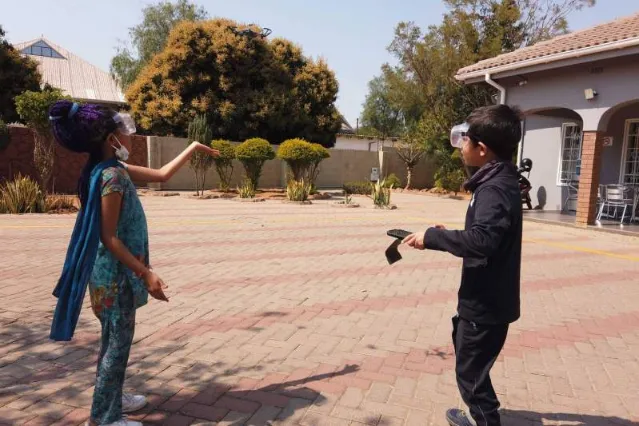
Students will be learning the basics of flying, programming on drones. They will be using sensors and Electronics and learning about them. They will be learning about Drone development and advancement in this technology.
- 300+ Learners
- 6 Weeks Course
Level 1
Teacher Training Course
Elevate your teaching career! Gain hands-on experience and innovative techniques to inspire the next generation of engineers and scientists.
- August
- 6 Days Program
Level 2
Teacher Training Course
Elevate your teaching career! Gain hands-on experience and innovative techniques to inspire the next generation of engineers and scientists.
- December
- 6 Days Program
Learning Outcomes (Level 1)
i. STEM Pedagogy
Develop effective teaching strategies for STEM subjects.
Create engaging STEM lesson plans and activities.
ii. Constructing Machines
Understand mechanical engineering concepts.
Instruct students in building and operating machines.
iii. Coding
Learn programming languages and concepts.
Instruct students in coding for software and game development.
iv. Robotics
Understand the principles of robotics and automation.
Build and program robots for various applications.
v. 3D Printing and Designing
Master 3D printing technology and design software.
Teach students to create 3D models and prototypes.
vi. Drones
Gain knowledge of drone technology and applications.
Teach students to operate and program drones safely and effectively.
Learning Outcomes (Level 2)
i. AI (Artificial Intelligence):
Develop a deep understanding of AI principles and techniques.
To be able to Instruct students in AI applications and programming.
ii. IoT (Internet of Things):
Understand IoT concepts and technology.
To be able to guide students in creating IoT projects and applications.
iii. Animation:
Master animation software and techniques.
To be able to teach students to create animations for various media.
iv. Electronics:
Gain proficiency in electronic circuits and components.
To be able to instruct students in electronic project design and construction.
v. Laser Cutting:
Learn laser cutting technology and its applications.
To be able to teach students to use laser cutters for precise design and fabrication.
Like every area of education, STEM has its lexicon of fancy terminology. We have assembled a list of key STEM vocabulary that we will be using throughout the course. Some of these concepts you won’t encounter until much later, but it will be helpful to review the list now as a preview of what is to come. You can also come back to this list at any time if you are confused about a term that is being used.
21st Century Skills:
A set of core skills that equip students to collaborate, adapt, solve problems, and face unknown challenges.Career and Technical Education (CTE):
Courses that provide skilled trades and career-oriented subjects, often including health-care, construction, communications, audio-video technology, agriculture, and information technology.Constructivism:
A theory of education which describes student learning as the construction of knowledge through experience and reflection.Engineering Design Process:
A specific, step-by-step approach that engineers use to design products and solve problems. This process is frequently used in STEM lessons.Gamification:
The integration of game-based elements and mechanics for the purpose of increasing student engagement and success.Inquiry-Based Learning:
A teaching method that is centered around discovering the answers to student-generated questions.Maker Movement:
A community of amateur DIY enthusiasts who blend arts, crafts, engineering, science projects, and the Do-It-Yourself mindset.Problem-Based Learning:
Teaching method used to implement real-world problems to promote learning.Professional Learning Community (PLC):
A community for teachers to share information, collaborate, and learn from one another.Project-Based Learning:
The teaching method used for students to obtain new knowledge and skills by investigating and responding to complex questions or problems.STEAM:
Science, Technology, Engineering, Arts, and MathematicsSTEM:
Science, Technology, Engineering, and MathematicsTriz Methodology:
A problem-solving methodology based on logic, data, and research, not intuition.A rigorous task:
An assignment or activity that challenges students to think critically, apply knowledge, and engage in complex problem-solving. It goes beyond simple recall or regurgitation of information and requires students to analyze, evaluate, and synthesize information to arrive at meaningful conclusions.Pedagogy:
Pedagogy refers to the way of teaching students, whether it is the theory or practice of educating. It is a relationship between the culture and techniques of learning. The main aim of pedagogy is to build on the previous learning of the students and work on the development of skills and attitudes of the learners.
